MoreExam
1. Question Content...
EXPLANATION
Answer: X - EXPLANATION Content.
Question1: You are asked to help a customer architect a private cloud solution using a tightly integrated converged infrastructure that can be managed by the vendor. You decide to present FlexPod Managed Private Cloud as a solution.In this scenario, what are three results of this solution?(Choose three.)Response:
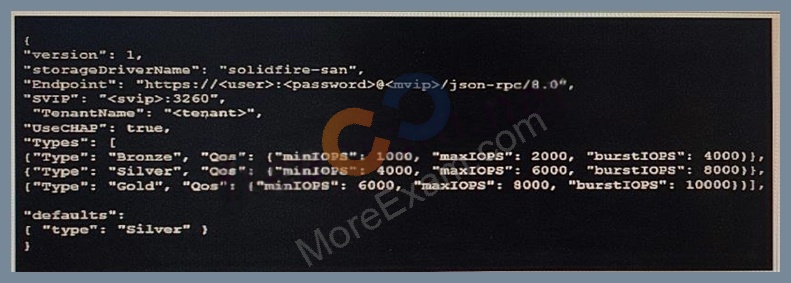
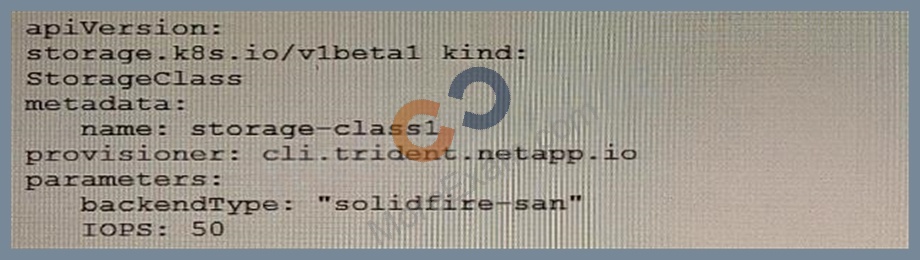
Question2: Click the Exhibit button.Refer to the exhibit and the Storage Class information shown below.What are the minimum IOPS, maximum IOPS, and burst IOPS assigned to the persistent volumes that were created by Trident?
Question3: You are writing an Ansible playbook and using the official NetApp modules. You must provide credentials for a NetApp ONTAP cluster in a secure manner. Which two actions should be used to accomplish this task?(Choose two.)Response:
Question4: A customer is experiencing an I/O bottleneck with one VMware hosted workload in their NetApp HCI cluster that is part of their hybrid cloud. The solution must be immediate and non-disruptive.In this scenario, which corrective action should the customer perform?Response:
Question5: You have received an internal request for persistent storage where the developer would like to be able to specify the filesystem.Which three NetApp Trident backend storage drivers would satisfy the requirement? (Choose three.)
Question6: You are sending API commands to NetApp Cloud Manager. In this scenario, which type of authorization is used?Response:
Question7: You have a NetApp ONTAP Select instance that is serving a 400 GB nfsv3 export to an IoT application.You need to run AI in AWS on this dataset for both reads and writes to update metadata. The master copy of the data must remain in ONTAP Select.In this scenario, which NetApp technology will enable the capability for a master on-premises copy and a remote AWS copy of the same dataset?Response:
Question8: You are setting up a DevOps practice for your company. In this scenario, which three tools would you use?(Choose three.)Response:
Question9: Your customer has problems scaling their on-premises compute infrastructure for their Apache Spark clusters; costs are growing rapidly.The customer wants to move their Spark applications to the cloud but is concerned about the difficulty of provisioning and managing their Spark clusters in the cloud and the associated compute costs for hosting their workloads.Which product would satisfy their requirements?Response:
Question10: During software development, a team creates use cases, class diagrams, Unified Modeling Language models, software architecture documents, requirements documents, and design documents.Collectively, in this scenario, what are these tangible by-products called?
Question11: Which file would you configure to ensure that certain files are never committed to a local Git repository?Response:
Question12: Your company asks you to deploy a new version control management system. In this scenario, which two tools would accomplish this task?(Choose two.)Response:
Question13: You deployed a NetApp HCI private cloud system using a six-cable configuration. You are asked to make changes to the network configuration post-deployment. In this scenario, which configuration change is supported?Response:
Question14: You are deploying StorageGRID software on-premises. You have a requirement to keep a second copy of specific production objects in Amazon Glacier. In this scenario, which native NetApp technology provides this functionality for specific objects?Response:
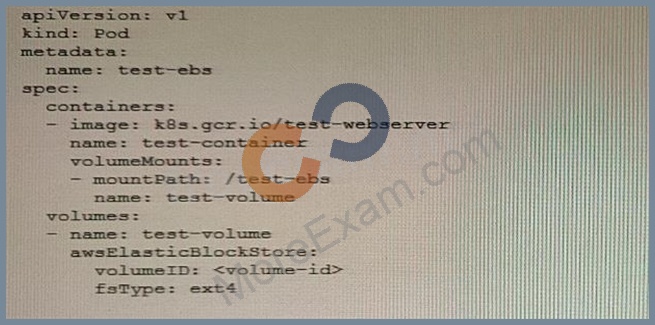
Question15: Click the Exhibit button.You are reviewing a Kubernetes manifest to deploy an Amazon Elastic Block Store (AWS EBS).Which two Kubernetes API object types are shown in the exhibit?
Question16: What are two differences between a container and a VM?(Choose two.)Response:
Question17: You are deploying a containerized application to track user data. However, every time the container is re-created, user data is lost. What do you need to save this data?Response:
Question18: You are creating a new meme generation application and are using containers for service chaining. The end user uploads the original image to one container, the image resolution modifier to another container, and the text overlay to a third container.In this scenario, knowing that you have NetApp ONTAP storage available to you, which solution will allow each container to access the same data?Response:
Question19: You are writing a script to verify, update and display discrepancies of IT assets in the corporate content management database (CMDB). You must use the RESTful API to interface with the CMDB server. What are two common formats for the RESTful API responses?(Choose two.)Response:
Question20: You have virtual desktops that are hosted in both AWS and Azure. The desktops need to connect to your on- premises database by using Azure ExpressRoute and AWS Direct Connect. In this scenario, which routing protocol supports this connectivity?Response:
Question21: Your software development team is working on a new stateful containerized application that requires persistent storage. The team develops software on their local workstations prior to deploying to test and production environments.The team wants to create a consistent experience across the various stages of the software development life-cycle. In this scenario, which NetApp product should the team use?Response:
Question22: You are performing a default deployment using Kubernetes. In this scenario, where is persistent data stored?Response:
Question23: A customer has deployed a NetApp HCI environment and has configured SnapMirror replication relationships to Cloud Volumes ONTAP in AWS. After migrating Cloud Manager from on-premises to AWS, the customer can no longer create new replication relationships between existing environments.The Cloud Manager can access the Cloud Volumes ONTAP working environment and the current SnapMirror relationships continue to make successful transfers of data.In this scenario, where would you locate the source of the problem?Response:
Question24: Click the Exhibit button.Referring to the exhibit, which two source resources? (Choose two.)
Question25: You are automating the build process of several NetApp ONTAP Select instances. You want to automate the installation of license keys using the ONTAP REST API that is expecting an array as valid input.Which automation process is correct in this scenario?Response:
Question26: You have an application that runs once per month to provide analytics and report generation. You are asked to use cloud compute resources to run this application. However, your existing environment consists of a single AFF A300 HA pair.In this scenario, which two actions would satisfy the requirements?(Choose two.)Response:
Question27: You are instructed to move towards an infrastructure as code process. You need to be able to track changes to the files that you are using. In this scenario, how would you satisfy the requirement?Response:
Question28: A customer was running a traditional application with the data being provided by an NetApp ONTAP NFSv3 export. The customer is now migrating that same application to run with a container in a Kubernetes environment using NetApp Trident.In this scenario, how would the customer ensure that the new container-based application has access to the same data?
Question29: You are asked to implement a monitoring solution for your VM environment that is hosted on NetApp storage; however, you have no budget for this task. You decide to use Cloud Insights to accomplish your task. What are two capabilities of this solution?(Choose two.)Response:
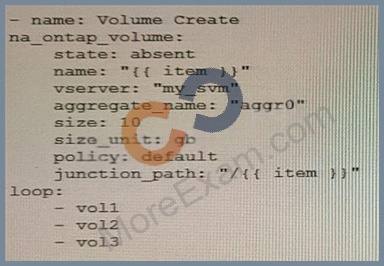
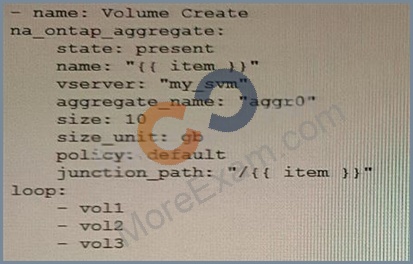
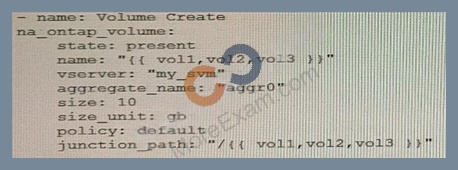
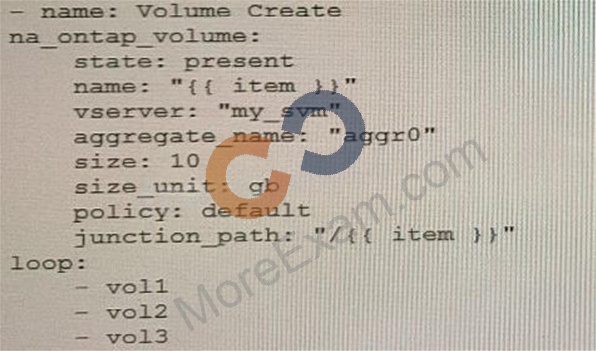
Question30: You are creating an Ansible playbook to deploy a NetApp ONTAP cluster. You want to take advantage of a loop to automate the creation of several volumes.What would accomplish this task?A)B)C)D)
Question31: Your software development team creates and deploys applications to Kubernetes. You want to provide the team with metrics from the applications resource usage. In this scenario, which two products would satisfy this requirement?(Choose two.)Response:
Question32: A customer wants their main data set to be stored in their primary location while providing a writable, persistent cache in another location closer to the consumer.Which two solutions will satisfy the customer's requirements? (Choose two.)
Question33: You recently started at a new company where the persistent storage for Kubernetes was not provided by NetApp. You want to make sure you take full advantage of the additional annotations available from your NetApp storage.In this scenario, which three parameters would you use to accomplish this task? (Choose three.)
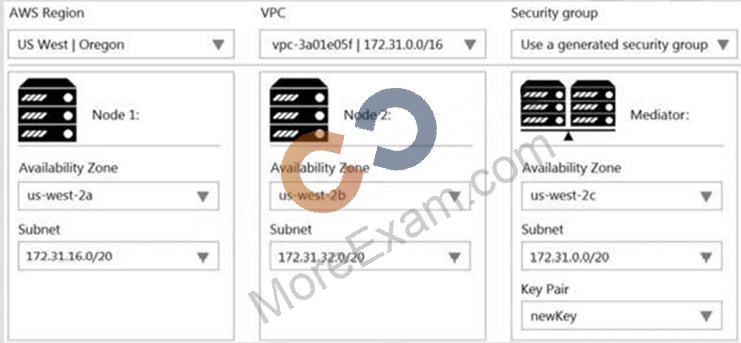
Question34: You have an on-premises AFF A320 cluster that will use SnapMirror to replicate all data to the cloud instance shown in the exhibit.Which action will enable end-to-end connectivity for SnapMirror?Response:
Question35: Which three volume workflows are supported by Trident for Kubernetes?(Choose three.)Response:
Question36: What are three version control processes? (Choose three.)
Question37: You must have a firewall adjusted to allow Ansible to work with ONTAP and Element software. In this scenario, which port must be allowed for both systems?Response:
Question38: You have an on-premises AFF A400 system with SnapMirror replication to a Cloud Volumes ONTAP system. You have a corruption on a source volume and you want to make the destination volume in Cloud Volumes ONTAP writable.In this scenario, which action would you perform on the replication relationship in Cloud Manager?Response:
Question39: You are deploying a new container application with persistent storage that is set up with StatefulSets storage. You are concerned about the number of persistent volumes during scale-up and scale-down activities.In this scenario, which statement is correct?Response:
Question40: You have a single node Cloud Volumes ONTAP (CVO) system in AWS.In this scenario, which two activities will cause system downtime? (Choose two.)
Question41: You have a 4-node AFF A800 cluster that is serving file data. You are required to replicate copies of the data volumes directly to Amazon S3.In this scenario, which two NetApp tools satisfy this requirement? (Choose two.)
Question42: You are asked to design a Trident solution on NetApp ONTAP for a highly scaled Kubernetes environment that contains thousands of stateful microservice applications. Which ONTAP Trident driver should be used in such a highly scaled environment?Response: